Reverse-Time Storytelling as Psychological Horror
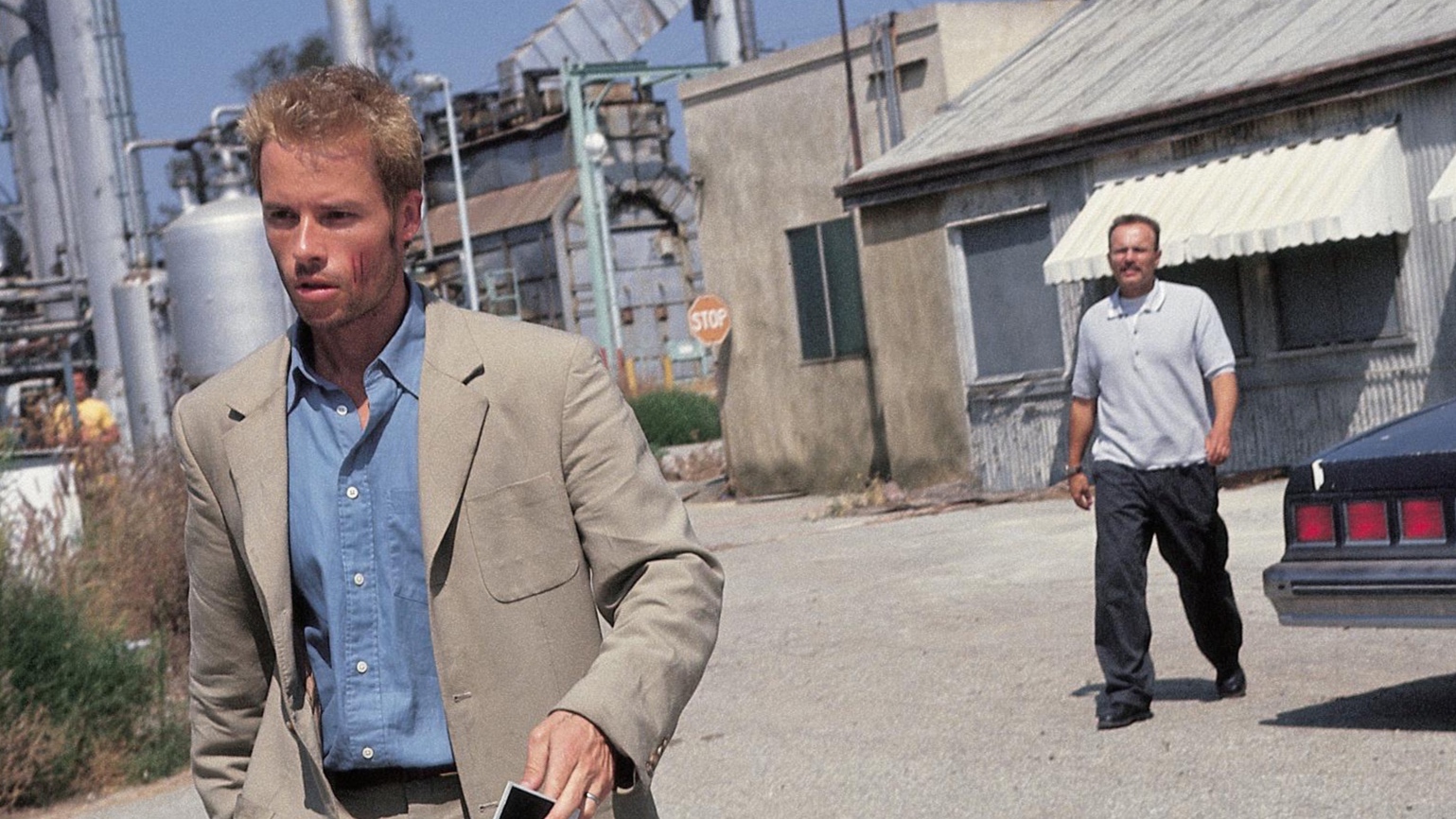
Leonard Shelby (Guy Pearce) brandishes a crucial Polaroid photo in a gripping reverse-chronology narrative. The very structure of Memento is designed to disorient and unsettle. Christopher Nolan tells the story backward – opening with a scene literally running in reverse. A Polaroid photograph undevelops before our eyes, its image fading away instead of appearing. A bullet leaps from the floor into the barrel of a gun, and a pair of glasses flies from the ground to someone’s face. This arresting sequence immediately creates a sense of uncanny tension.
By beginning at the end and working backward, Nolan immerses us in Leonard’s fractured perspective. We experience events just as he does: with no clear memory of what just happened, living in a perpetual, disjointed present. That alone generates constant dread – we’re anxious about what took place mere moments before. It’s a brilliant narrative technique that instills a deep psychological horror, forcing viewers to question cause and effect at every turn.
Years later, Nolan would revisit the concept of reversed time in Tenet, which features actual “time-inversion” action. But in Memento, the reverse storytelling exists to heighten our sense of disorientation. As an audience, we’re unsure about what Leonard did or how the previous events led here. This is how a simple “revenge thriller” morphs into a nightmare of confusion and paranoia, unveiling horrors piece by piece.
The Terror of Memory Loss and Unreliable Reality
Memento asks a chilling question: What if you could never trust your own memory? Leonard Shelby suffers from anterograde amnesia – every 15 minutes, his mind resets. He’s hunting his wife’s murderer but can only recall events for a short while. This condition starts off tragic but quickly becomes terrifying. Leonard awakens in strange places, surrounded by Polaroids and cryptic tattoos that he’s left for himself, yet he has no clue how he got there.
That is where the horror lies: he doesn’t know who or what might be lurking around him, what he’s done, or whether he’s crossing moral lines. By the time we piece together a semblance of the truth, we learn Leonard might already have gotten his revenge – and he’s now killing people for reasons that exist only in a mind that keeps forgetting reality. The idea that our hero could be unknowingly monstrous is deeply unsettling.
Is Memento a horror film? Traditionally, it’s labeled a psychological thriller, but it feels horror-adjacent in its execution. Nolan uses Leonard’s amnesia much like a classic horror director uses darkness to keep viewers on edge. The fear stems from the protagonist’s own mind betraying him, threatening to lead him (and us) into moral oblivion. That’s a gut-punch rarely seen in typical thrillers, and it leaves a lasting feeling of existential dread.
Eerie Symbolism: A Dead Man’s Suit and a Haunting Mission
Another layer that gives Memento an almost ghostly vibe is the eerie symbolism throughout Leonard’s quest. At one point, after killing a man he believes is responsible for his wife’s death, Leonard literally puts on the dead man’s suitand drives off in the dead man’s car. It’s a haunting moment for the audience, because we know the truth behind these items, but Leonard doesn’t.
That surreal image – our hero wearing a corpse’s clothes and using his victim’s belongings – casts Leonard in a spectral light. He looks like a wandering soul, doomed to inhabit someone else’s identity while forgetting his own. The film dwells on issues of identity and denial, suggesting that Leonard clings to his “mission” because it’s all that anchors him in a world he can’t retain. He becomes a ghost hunting phantoms, no longer fully present in reality. It’s a brilliant, chilling representation of how he’s cut off from normal human experience and is essentially living in a self-imposed purgatory.
Carrie-Anne Moss’s Chilling Turn as a Femme Fatale
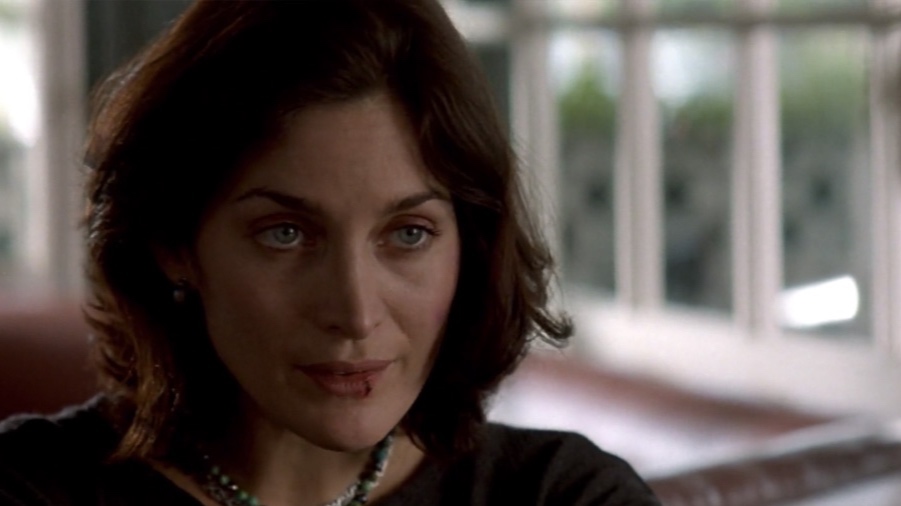
Carrie-Anne Moss, widely recognized at the time for The Matrix, delivers one of Memento’s most bone-chilling performances as Natalie. She initially appears sympathetic, offering Leonard help in his quest. But in one pivotal scene, she manipulates him with savage cunning. After provoking Leonard until he hits her, she then slips outside, hides all the pens, and returns pretending another man assaulted her. When Leonard’s short-term memory resets, he believes Natalie is a victim and rushes to get revenge on her supposed attacker.
It’s psychological warfare at its finest, revealing the depth of Natalie’s cruelty and how she exploits Leonard’s amnesia for her own ends. Moss’s performance is icy and brutal, making Natalie arguably one of Christopher Nolan’s most quietly terrifying characters. She doesn’t need supernatural powers or slasher violence to embody evil – she merely needs to weaponize her target’s biggest weakness.
Nolan’s Darkest Puzzle: Legacy and Influence in Psychological Horror
Is Memento Christopher Nolan’s darkest movie? The evidence is strong. Unlike the larger-than-life scale of his later films, Memento is intimate, focusing on one tormented soul. Its bleak revelations and ambiguous morality push it beyond standard thriller territory into something akin to a psychological horror piece. By the end, we discover Leonard is trapped in a self-perpetuating cycle, possibly dooming others to fall under his misguided crusade forever. It’s a fate more disturbing than any typical cinematic punishment.
While Nolan would go on to create more sprawling stories, Memento remains uniquely grim in his filmography. Its focus on memory, identity, and self-deception has influenced countless psychological thrillers since. Talk to anyone who loves mind-bending cinema or memory loss narratives, and Memento inevitably comes up. It’s become a cornerstone for exploring unreliable narrators, time-scrambled storytelling, and existential dread. The question “Is Memento actually a horror film?” lingers precisely because it leaves us so deeply unsettled – even without classic horror tropes.
Join the Discussion on Screamify™
If you haven’t seen Memento, you’re missing out on one of the most haunting, cerebral experiences in modern cinema. Christopher Nolan took a simple revenge premise and turned it into a puzzle-box thriller brimming with dread and psychological horror. The film’s reverse narrative, chilling amnesia twist, and morally compromised characters prove that sometimes the scariest place is inside our own minds.
We want to hear your thoughts: Is Memento a horror film in disguise? Or is it purely a psychological thriller with just enough dread to unnerve viewers? Head to the Screamify™ Community and join the conversation! Share your theories on Leonard’s final fate, Carrie-Anne Moss’s intense performance, and whether this might actually be Nolan’s scariest masterpiece. While you’re there, check out more of our indie psychological thriller reviews and discussions on how other filmmakers blend horror and psychological suspense.
At Screamify™, we love championing bold, anti-Hollywood storytelling – and Memento is a perfect example of how indie-minded passion can redefine entire genres. So whether you’re new to Nolan’s early work or revisiting this twisted tale, we invite you to dive deeper into the psychological horror of Memento and debate its legacy with fellow fans. After all, if memory is fragile, maybe the best way to hold onto the experience is to keep talking about it. Let’s explore the darkest corners of cinematic storytelling together, one Polaroid at a time.